

When your curious kids are bored, spend some quality time with them making a bottle thermometer to test relative temperatures! This a surprisingly quick and easy science project that has a great, "Wow! How does that work?" factor.

Did you even know it was possible to make a thermometer at home? And out of a bottle? Annie from Bird and Little Bird is here today with this intriguing science project: how to make a homemade thermometer. Fortunately, no mercury is required.
How to Make a Bottle Thermometer
These makeshift thermometers are one of those stand-by science projects that I ran across again and again during my years as a teacher. I never quite understood why they were supposed to be so cool — until we made one.
Indeed, this little experiment turns out to be weirdly, ridiculously fun. Maybe it is because it works so well while still being so easy to make. Or perhaps it has something to do with the fact that the effects of the experiment can be relatively dramatic, making it almost like a toy rather than an instructional tool. My daughter and I had great fun making a bottle thermometer, you will too!
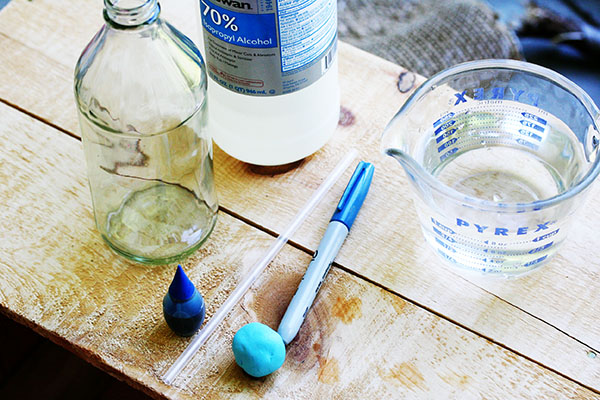
Materials
All of the materials are common household items you may already have at home!
- empty glass bottle
- water
- rubbing alcohol
- food coloring, any color
- a clear straw
- modeling clay
- a marker
Step by Step
Begin by gathering up all of your materials. We used a glass bottle from the bulk section at the grocery store (it used to hold maple syrup) and a clear plastic straw that we snagged the last time that we stopped for a smoothie.
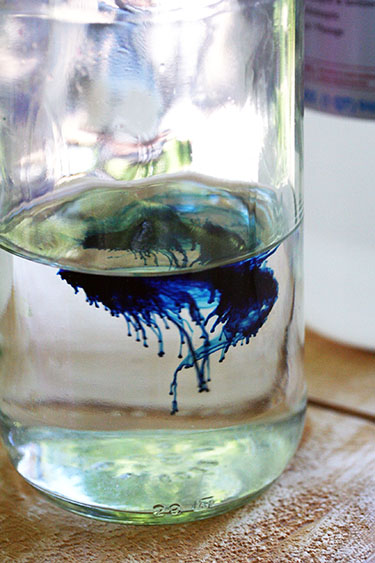
Fill the bottle ¼ full of plain water. Next, add an equal amount of rubbing alcohol so that the bottle is half full. Add a few drops of food coloring.
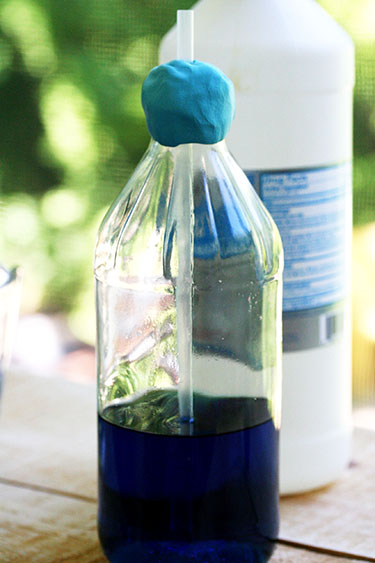
Place the straw in the bottle, and holding it so that it does not touch the bottom but is suspended slightly in the liquid, wrap the modeling clay around the top of the bottle and the straw. This will hold the straw in place and prevent it from falling farther into the bottle.
MORE: Weather experiment: How to make fog in a bottle
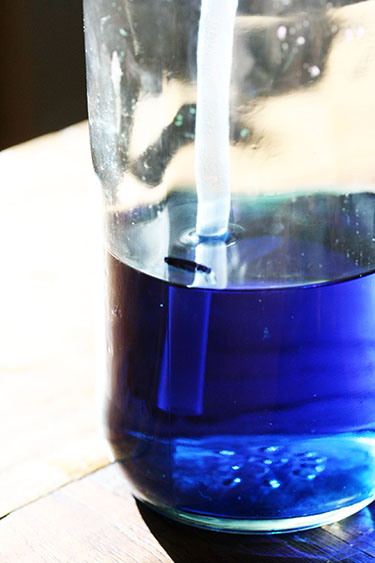
Pay attention to how far up the straw the liquid now comes. Use the marker to mark the outside of the bottle at the spot where the straw goes from being filled with liquid to being empty (i.e. the line where the liquid stops filling the straw). This line indicates the current temperature where the bottle is at the moment.
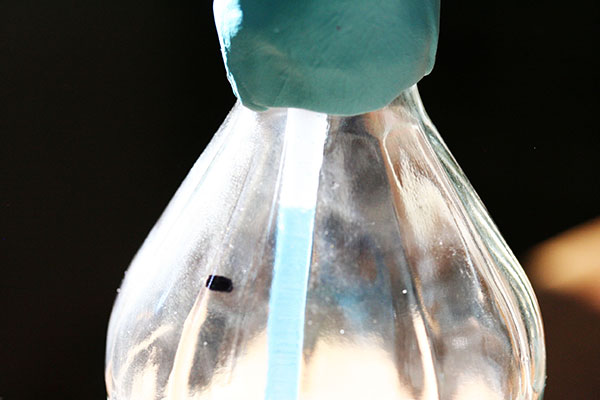
Now, move the bottle to different locations where the temperature is likely to differ. Notice how the liquid either rises or sinks down in the straw. Have your child notice when the liquid rises and falls relative to how warm they think it the location is.
In warmer temperatures, the liquid will rise. In cooler temperatures, it will sink.
Although different locations in a single room may not yield dramatic results, kids will love to experiment with more extreme temperatures. Try placing the bottle in direct sunlight, on a porch outside on a warm day, or in the refrigerator to see the liquid in the straw rise and fall with the temperature variation.
As an extension, kids can record their observations to practice learning the scientific method.
MORE: Weather tracking experiment for kids
The Science at Work
Your kids will be eager to know the science behind how a bottle thermometer works!
Liquid expands when it is warmed, and contracts when it cools. There is only so much space at the bottom of the bottle, so when the colored liquid gets warmer, it rises in the bottle and is forced up into the straw.
When the liquid is in a cooler environment again, it will begin to contract, forcing the straw down. While experiment won’t give you an exact temperature, it will show relative temperatures, allow kids to generally see which environments are warmer or cooler than others.
MORE: Easy home science experiments
Annie Riechmann is an educator, blogger, and mama to two small people who lives in the Boston area. Annie is also the creator and publisher of Alphabet Glue, a literacy themed e-magazine for families. She is a big believer in tree climbing at any age and of wearing knee-high striped socks. You can visit her at her online abode, Bird and Little Bird, where she writes about everything from books and babies to laundering snowpants and the joys of putting a husband through residency.

Phyllis at All Things Beautiful says
This is wonderful. I love it.
Natalie says
This is certainly very cool! I think we'll do it one of these days. Pinning it.
PragmaticMom says
I'm glad that you don't need mercury. What a great experiment! Pinning it and trying it out next week with my kids!
Erica MomandKiddo says
This experiment was a revelation! I had no idea this was even possible.
Deceptively Educational says
My son would go crazy over this! Thank you for sharing. This just got added to our "must do" list. I'm featuring this tomorrow at the After School Linky Party. Stop by to check it out and keep sharing!
Shaunna (@Shaunna_FFL) says
We tried this experiment once when I was teaching in the classroom. I was so excited to see your version linked up to Discover & Explore. I'm featuring you today in a collection of weather experiments for kids. Thanks for linking up!
Richard Pearce says
Looks really great! I can't wait till I do this with my 8-yr-old grandson - he lives in Singapore and I live in UK, but I'm going over there in the new year. But just one thing: surely it is the air over the liquid that is doing most of the expanding? It usually does.
Erica MomandKiddo says
That may be, Richard. Clearly you know much more about the science of it than I do!